Story time
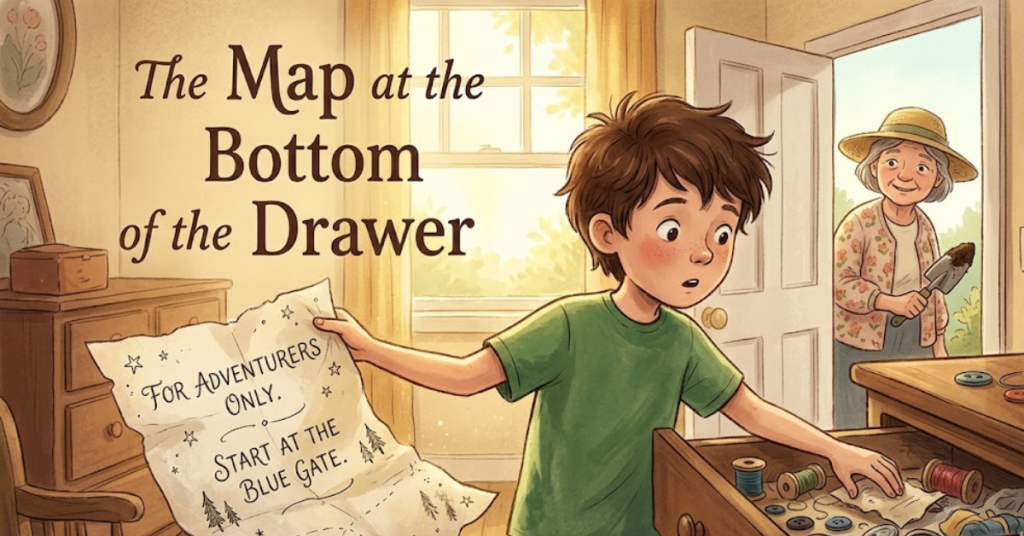
The Map at the Bottom of the Drawer
Listen to Story
Gentle bedtime narration with natural pauses.
Ready for a cozy story time.
Milo found the map on the third day of summer.
He was staying at his grandmother’s house while his parents were away, which was mostly brilliant because his grandmother let him stay up late and eat cereal for dinner. He was rummaging through her sewing drawer looking for a rubber band — to make a catapult, obviously — when his fingers closed around something crinkled and stiff.
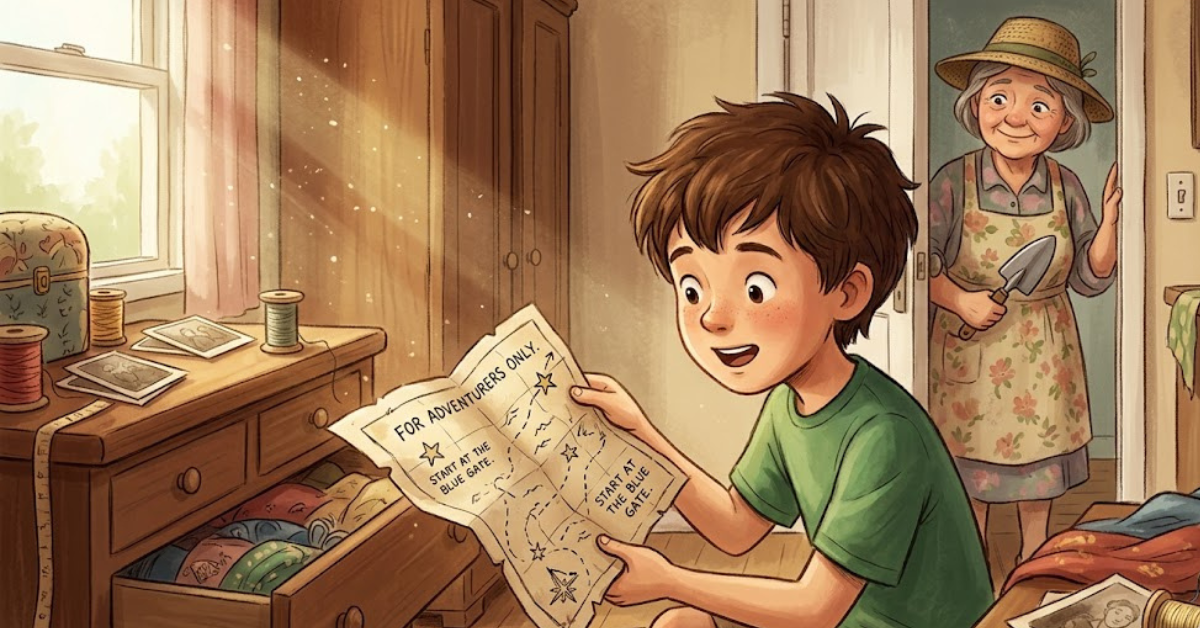
He pulled it out.
It was an old piece of paper, folded into quarters, soft at the creases. When he unfolded it carefully, he found a hand-drawn map: ink lines, small neat labels, little drawings in the corners. Stars marked six different spots around what was clearly the neighbourhood he was standing in — just older, and seen with different eyes.
At the top, in faded looping handwriting:
*For adventurers only. Start at the Blue Gate.*
“Nana,” Milo called. “What’s this?”
His grandmother appeared in the doorway, wearing her gardening hat and holding a trowel. She looked at the map. Something crossed her face — something too quick to catch.
“Where did you find that?”
“The sewing drawer.”
She was quiet for a moment. Then: “That was mine. When I was about your age.”
“Did you make it?”
“I made it with my best friend,” she said. “We spent one whole summer following it.” She turned the trowel over in her hands. “Every spot on that map is somewhere in this neighbourhood. Hidden in plain sight.”
“Can I follow it?” Milo asked.
His grandmother smiled — a real, full one, the kind that makes wrinkles at the corners. “You may,” she said. “But you’ll need a companion. Adventures require companions.”
—Milo called Jess.
Jess lived two streets away and was Milo’s best friend because she was the only person he knew who thought ideas through almost as fast as he did.
“Old map,” said Milo, when she arrived. “Hidden adventure spots. Neighbourhood. Let’s go.”
Jess looked at the map for exactly four seconds. “Right,” she said. “Where’s the Blue Gate?”
The Blue Gate turned out to be the faded blue garden gate at the end of Milo’s grandmother’s lane — peeling and crooked and something you would walk past every day without looking twice.
“Start here,” Jess read. “Follow the wall to where the fig tree leans. Look UP.”
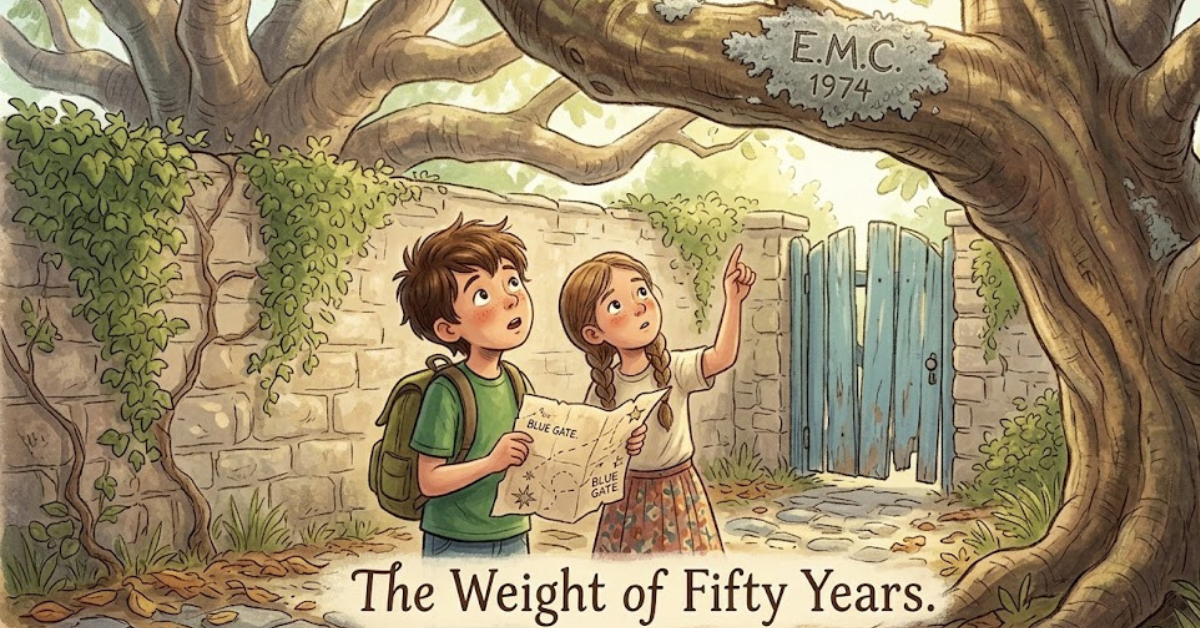
They followed the stone wall along the lane. The fig tree was ancient and enormous, its branches reaching over the wall like arms. They looked up.
Carved into the bark, almost completely hidden by a scar of grey lichen, were three initials: *E. M. C.*
“That’s Nana’s name,” said Milo softly. “Eleanor Mary Carroll.”
They stood for a moment beneath the carved letters, feeling the weight of fifty years of days all at once.
—
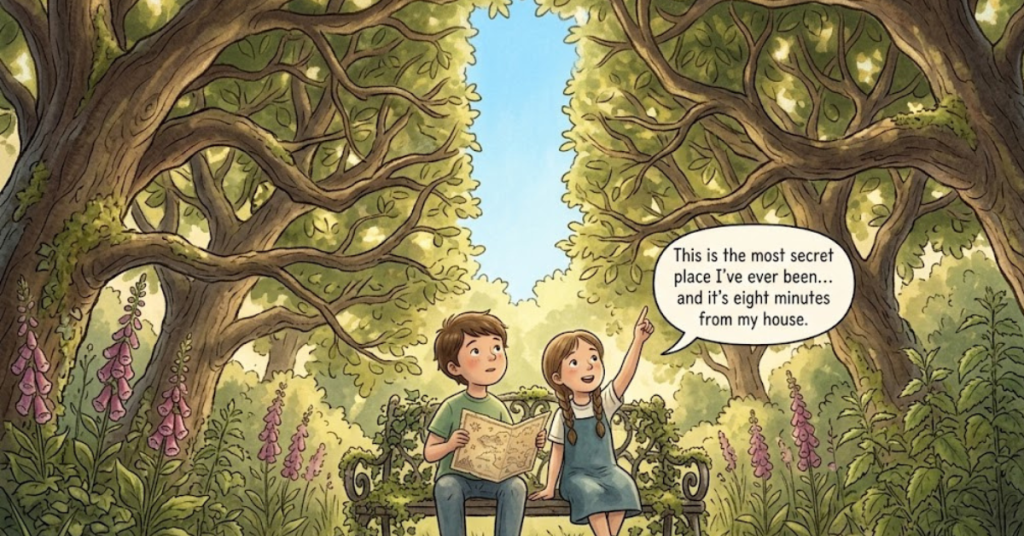
The second spot on the map was marked *The Hidden Garden* and led them through a narrow gap between two houses that Milo had assumed led to nothing. It led to a garden — wild and untended now, full of foxgloves and nettles and a stone birdbath the colour of old bone. At the centre, half-swallowed by moss, was a small iron bench.
They sat on it for a while. Above them, through the overgrown canopy, they could see a slim rectangle of blue sky.
“This is the most secret place I’ve ever been,” Jess said, “and it’s eight minutes from my house.”
—
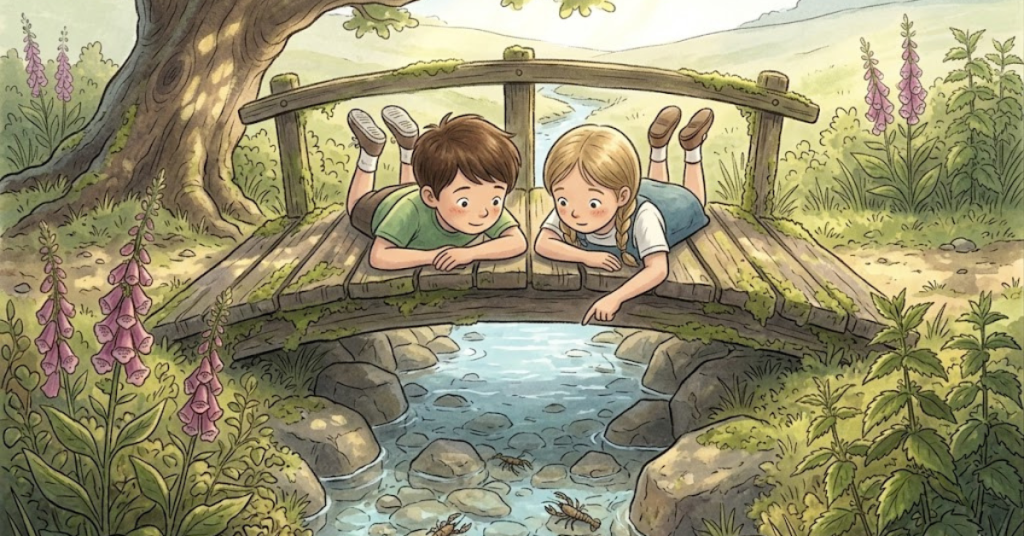
The third spot was a bridge over a thin brook — not much more than a drainage ditch, really, but if you lay on your stomach on the bridge and looked down, you could see crayfish moving between the stones.
The fourth was a hollow in an oak tree that contained, inexplicably, a smooth white stone and a glass marble.
*Someone else has been here*, thought Milo. *Recently.*
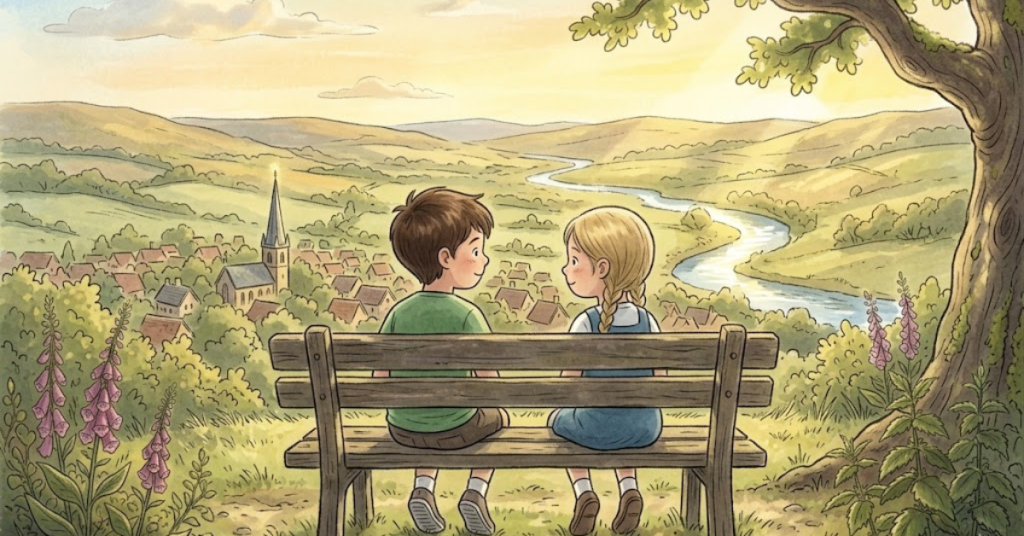
The fifth was a viewpoint at the top of a hill: just a park bench, ordinary in every way, but from it you could see the entire valley — rooftops and church spire and the glint of the distant river and the hills beyond — laid out like a painting.
They sat there for a long time without speaking.
—
The sixth and final star on the map was marked simply: *The Best Bit.*
It led them to the back wall of Milo’s grandmother’s own garden.
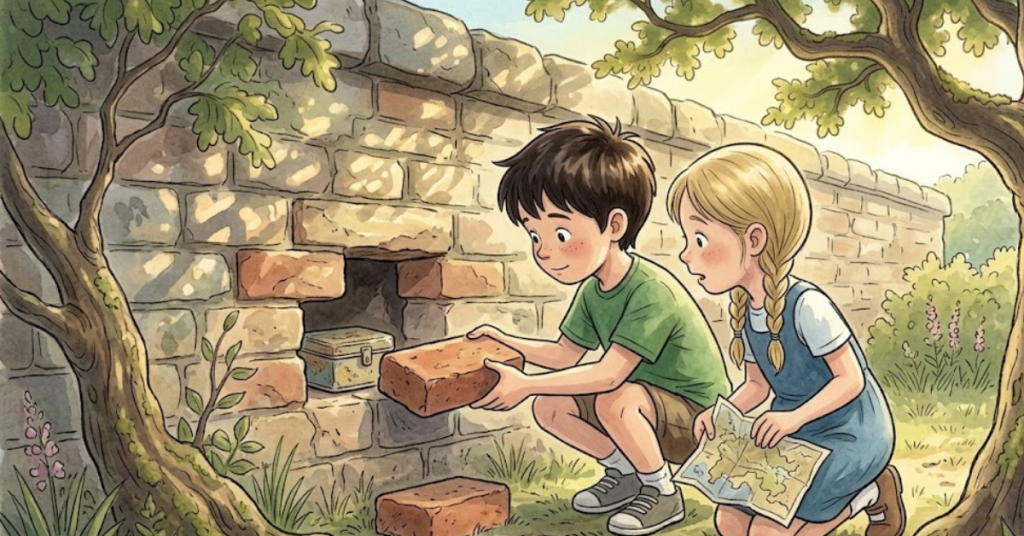
There was nothing there. Just a wall with a slightly different stone near the bottom — older, rougher, a different shade. Milo crouched and looked at it. And then he saw it: a loose brick.
He pulled it free.
Behind it was a small hollow in the wall.
Inside the hollow was a small tin.
Inside the tin was a folded piece of paper — fresh, crisp, new — that said:
*Congratulations, adventurer. You made it. Now add your names below and leave the tin for the next one.*
Below this were two names, written in the looping handwriting of the map.
*Eleanor Carroll.*
*Patricia Hughes.*
Followed by a space, and beneath the space, in newer ink, three more names added over the years: *James. Tomoko. Saoirse.*
Milo and Jess looked at each other.
Milo dug in his pocket and found a stubby pencil.
He wrote their names below the others. *Milo. Jess.*
They folded the paper, put it back in the tin, put the tin back in the hollow, replaced the brick.
Then Jess pulled the map out of her pocket. She turned it over.
On the back — and this was the thing that made them both completely still — was a blank page.
At the top, in fresh ink that definitely hadn’t been there that morning, was written:
*Your turn.*